If you’ve driven down Route 138 or maneuvered through the side streets of Brockton this week, you would probably understand the mutual feeling drivers had. That heart-stopping thud that echoes through the cabin, making you wonder if you just left your bumper behind.
It’s late January 2026, and the “Massachusetts rollercoaster” is in full swing. We’ve had just enough freezing rain followed by deep freezes to create the perfect conditions for frost heaves. These aren’t just your standard potholes; these are literal mountains of asphalt pushed up by the expanding frozen ground.
When you hit one of these at 40 mph, your car’s suspension takes the kind of hit it wasn’t designed to handle daily. As experts, we keep seeing a line of cars out the door this month specifically for suspension repair. If your ride has started feeling more like a turbulent flight than a smooth drive, here is what you need to know about the damage lurking under your floorboards.
The “Silent” Strain: What Frost Heaves Do to Your Car
Most people think that if their tire didn’t pop, they successfully got away with it. Unfortunately, suspension damage is often cumulative. It’s the slow wear and tear that turns into an emergency three weeks later.
1. Blown Shocks and Leaking Struts
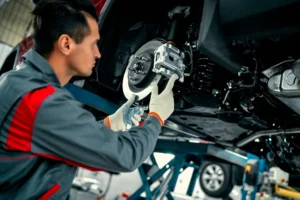
Think of your shocks like the “knees” of your car. They absorb the impact so your spine doesn’t have to. When you hit a frost heave, the pressure inside the shock cylinder spikes. This can blow out the seals, causing the hydraulic fluid to leak out. If you see “wet” or greasy spots behind your tires, you will find yourself going to a service center sooner rather than later.
2. The Misaligned Steering Wheel
Does your steering wheel point to 2 o’clock or 10 o’clock while the car is going straight? That’s the classic sign that a heave has knocked your alignment out of whack. Beyond being annoying, a bad alignment eats through your tires and puts massive stress on your steering rack. Getting a quick check for spooring and balancing can save you from buying a $1,000 set of tires in the near time.
3. Damaged Control Arms and Bushings
The bushings are the rubber cushions between the metal parts of your suspension. The extreme January cold makes this rubber brittle. When you hit a sharp bump, that brittle rubber can crack or tear. If you hear a “clunk” or “creak” every time you pull into your driveway, your bushings are likely toast.
Don’t Forget the “Underbelly” Danger
While you’re worried about your springs and shocks, don’t forget that these bumps can also reach up and grab your exhaust system. A frost heave that is high enough can scrape the bottom of your car, leading to a much-needed exhaust system repair. If your car sounds like a lawnmower after a rough ride, the bump might have cracked a manifold or loosened a flange.
When searching for auto repair, make sure you choose a shop that does a full under-car inspection. We’ve found that about 30% of cars coming in for suspension issues also have minor exhaust leaks caused by the same road conditions. We would by far recommend getting a full inspection to not go back and forth to service centers.
❓ Your January Suspension Survival FAQs
| The Question | The “No-Nonsense” Answer |
| Can I just wait until spring to fix my suspension? | You could, but it’ll cost you more. A bad strut leads to uneven tire wear and puts stress on your wheel bearings. Fixing it now might be significantly cheaper than a total overhaul in April. |
| Why is my car “drifting” on the highway? | Frost heaves often bend the tie rods or control arms. This changes how your car “tracks.” It’s a safety issue, especially when the roads are icy and you need every bit of control you can get. |
| How long does a suspension repair take? | Most common fixes, like replacing a strut or a ball joint, can be done in a single morning. We know you need your car back for the commute! |
| Is this covered under my warranty? | Usually, suspension parts are considered “wear and tear,” but if you hit a particularly massive heave that causes sudden failure, some insurance policies might help. It’s always worth asking experts for a detailed report. |
Why Local Expertise Matters Right Now
You could take your car to a big-box Boston automotive chain, but they don’t know the specific “pothole traps” on the way to the Westgate Mall or the nasty heaves in North Easton.
We live here, we drive these same roads, and we know exactly which parts take the most abuse during a Massachusetts winter and what are the most common issues for each model. When you look for an auto mechanic in Boston, you want someone who treats your car like it’s their own. We pride ourselves on being the local auto repair that residents trust to tell them the truth about what needs fixing versus what can wait.
Don’t let a bad bump turn into a broken car. Let’s get your alignment straight and your shocks checked before the next big storm hits.
📞 Did a frost heave get the better of your car today? Call Boston Auto Repair at 508-238-8162 or schedule your Suspension & Safety Check online today!