Walk outside right now in Brockton or Easton, and you’ll see it, that white, crusty film covering every car on the road. It’s the “New England patina.” While we’re all used to washing our windshields so we can actually see the road, there is a much more expensive battle happening under your EVs that most people are unaware of and completely ignore.
In January 2026, the road crews are laying down a heavy “brine” (that liquid salt mixture) to keep the ice at bay. For a traditional car, salt is bad. For an EV, salt can be a catastrophe. Why? Because your most expensive component, yes, the battery pack, is sitting just inches above that corrosive slush.
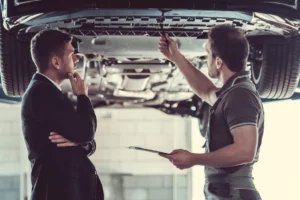
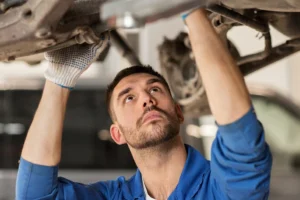
We’ve been hoisting more EVs onto the lifts lately, and what we’re finding isn’t pretty. If you want to protect your investment and avoid an auto repair in the near time, here is how to play detective with your undercarriage this winter.
The “Hidden” Danger: Why Salt Loves Your Battery
Most EVs have a large, sealed metal housing that protects the battery cells. While these are built tough, they aren’t invincible. Salt acts like a chemical “key” that unlocks the door for rust.
If salt gets trapped between the battery casing and the frame, it creates a “moisture sandwich.” This can slowly eat through the protective coatings. If the casing gets compromised, moisture can get in, leading to short circuits or “low isolation” faults that will leave you stranded. This will not just be a maintenance issue; it’s a safety issue.
🔍 3 Things to Look for (No Mechanic Degree Required)
You don’t need a lift to do a quick “driveway check.” Grab a flashlight and look for these three red flags:
- The “White Shadow”: Look at the plastic shields and metal plates under your doors. If you see thick, chalky white deposits that don’t come off with a quick splash of water, that salt is already starting to crystallize. If it’s on the plastic, it’s definitely on the metal parts of your suspension components too. Quickly get a proper wash to the bottom of your car to get the issue solved.
- Orange Flaking near Seals: Check the edges where the battery plate meets the car’s frame. If you see even a hint of orange or “bubbling” paint, that’s rust pushing its way out from underneath. This is a “call your auto mechanic immediately” moment.
- Frozen Slush “Icebergs”: After a drive on Route 123, check your wheel wells. Huge chunks of salty ice often get stuck there. These “icebergs” put constant pressure on your brake lines and suspension sensors. If they fall off while you’re driving, they can strike the battery casing like a stone.
It’s Not Just the Battery: The Salt “Side Effects”
While you’re worried about the battery, the salt is also attacking your mechanical parts. Because EVs are heavy, their suspension takes a lot of abuse. When salt gets into the bushings and ball joints, it dries out the rubber and corrodes the metal.
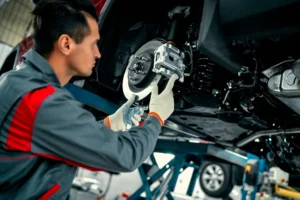
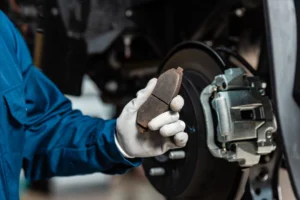
If you start hearing a “crunchy” sound when turning or going over bumps, you likely need a suspension repair. We also see salt seizing up the brake calipers. Since EVs use regenerative braking, the physical brakes don’t get used as much, meaning the salt has more time to sit there and “glue” the parts together. A quick brake check can prevent a seized brake in February.
❓ Winter EV Protection: Your Questions Answered
| The Question | The Real-World Answer |
| Can I just go to a regular car wash? | Yes, but you must choose the option with the “Undercarriage Wash.” Simply washing the paint does nothing for the salt eating your battery tray. In Boston, we recommend doing this at least twice a month in January. |
| Do EVs have an “exhaust” to worry about? | While they don’t have a tailpipe, they do have thermal management systems, basically radiators and hoses that keep the battery warm. Salt can corrode these fittings, leading to coolant leaks. If you see blue or pink fluid on your snow, search for your nearest auto repair right away. |
| Is “Undercoating” worth it for an EV? | It can be, but you have to be careful. You can’t just spray traditional oil-based undercoating on an EV because it can interfere with the battery’s cooling and electrical connectors. Ask your automotive experts for EV-specific options. |
| Why is my steering feeling “gritty”? | That’s likely salt and road sand getting into the steering rack or the strut bearings. A quick rinse at an auto repair shop usually clears it up before it causes permanent damage. |
The “Five-Minute” January Habit
Here is my best advice for 2026: Every time the temperature peaks above freezing 32°F, take a garden hose and spray out your wheel wells and the underside of your car for five minutes. It’s the cheapest “insurance” you’ll ever buy.
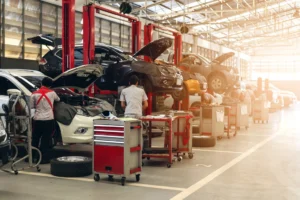
If you’re worried that the salt has already started its dirty work, don’t guess. Bring it in. At Boston Auto Repair, we know the “hot spots” where salt hides on Teslas, Rivians, and Bolts. We’ll get it on the lift, clear out the gunk, and make sure your battery housing is as solid as the day you bought it.
📞 Is your EV looking a little “salty” lately? Call Boston Auto Repair today at 508-238-8162 or book your Undercarriage Safety Check online!