If you’ve been driving around Brockton or Easton lately, you’ve probably noticed the sounds of the season. The birds are back, the ice is melting into giant puddles, and a high-pitched squeal coming from your front wheel. Or maybe your car feels like it’s “dragging” its feet every time you let off the gas on the way to the Expressway?
Throughout the year season change, this becomes a common issue in March and April. Most people assume their brake pads simply wore out. But more often than not, the pads had plenty of life left, but they just “self-destructed” because of a tiny mechanical failure that costs about ten bucks to prevent.
Forget the expensive rotors and the fancy ceramic pads for a second. Let’s talk about the Slide Pins: the unsung, grease-covered heroes of your stopping power.
The “Floating” Problem You Didn’t Know You Had
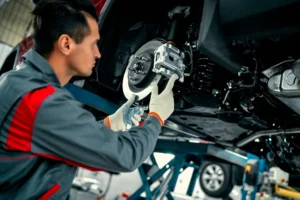
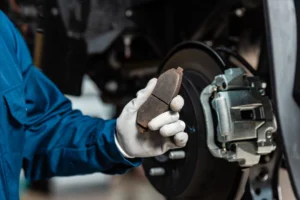
Most modern cars use what we call “floating calipers.” Imagine your brake system like a giant hand (the caliper) squeezing a spinning plate (the rotor). To work correctly, that hand needs to slide back and forth perfectly smoothly on two metal pins.
When you hit the brakes, the caliper slides “in” to squeeze. When you let go, it needs to slide “out” to release.
Here is where the Boston Factor, which only Boston drivers understand, turns into a nightmare. All winter long, your car has been pelted with liquid brine and road salt. That salt-water slurry loves to sneak past the tiny rubber boots protecting your slide pins. Once it’s in there, it turns the old grease into a sticky, rusty paste.
By the time we hit the end of March, that paste has “seized” the pins. Your brakes are now stuck in a permanent “half-squeeze.”
How $10 Saves You an $800 Headache
When your brake pins are stuck, the “self-destruction” begins. Since the caliper can’t slide back, one of your brake pads stays pressed against the hot spinning rotor while you’re driving 65 mph.
This leads to the “Triple Threat” of brake failure:
- Uneven Wear: You’ll have one pad that looks brand new and another that is worn down to the metal.
- Heat Warping: The constant friction creates massive heat, which warps your rotors. Now, every time you brake, your steering wheel shakes like a leaf.
- The “Cooked” Caliper: The heat gets so intense it can actually melt the internal seals of your brake caliper.
A tube of high-temp silicone brake grease costs about $10. A full brake job (pads, rotors, and a new caliper) can easily cost up to $800. It is the definition of “work smarter, not harder.”
The April Connection: Passing the Test
We are just days away from April, which means the April Inspection Panic is officially here. If your car is pulling to one side when you brake, or if your pads are wearing unevenly because of dry pins, you aren’t going to get that sticker.
In Boston, they don’t just check if you can stop; they check if the hardware is functioning safely. A “stuck” brake is a safety fail. Taking care of this “grease trick” now is the best way to ensure your car passes on the first try.
❓ FAQ: Everything You Need to Know About the “Slide”
| FAQs | Practical Answers |
| Can I just use WD-40? | Absolutely not. WD-40 is a solvent, not a lubricant. It will actually dissolve the remaining grease and cause the pins to seize even faster. You need “High-Temp Silicone Ceramic Grease.” |
| How do I know if my pins are sticking? | Does the car “creep” forward slowly when you let off the brake at a light? Do you smell a “burning” scent after a long drive? Those are classic signs of a stuck slide. |
| Can I do this myself? | If you can take a tire off and turn a wrench, you can grease your pins. However, if the pins are already rusted shut, you might need a pro with a torch to get them loose. |
| How often should this be done? | We recommend a “Clean and Lube” once a year. The best ideal time might be right now, after the salt is gone but before the summer heat hits. |
Stop the Squeal Before It Stops You
You’ve already put in the work to check your $20 Hero Thermostat and swap out your $15 PCV Valve. Don’t let your brakes be weak!
We don’t just slap new pads on and call it a day. We pull those pins, clean out the winter gunk, and apply the “Slide Secret” to make sure your brakes last as long as they’re supposed to.
Whether you’re commuting into Boston or just running errands, you deserve a car that stops as smoothly as it goes. Don’t wait for the “metal-on-metal” grinding sound to tell you that your brakes have finished eating themselves.
📞 Hearing a squeak or feeling a pull? Don’t let a $10 fix turn into an $800 disaster. Call Boston Auto Group at 508-238-8162 or book your “Spring Brake Refresh” online.