Let’s take a moment and picture this in mind. You’re in your kitchen, and you’ve got a pressure cooker whistling away on the stove. You know that if you just ripped the lid off while it was under full steam, you’d have a disaster on your hands.
Now, go out to your driveway in Boston and look at your car. Under that hood, you have a system that is doing the exact same thing every single time you drive to work. But instead of beef stew, it’s holding back scalding hot coolant at temperatures that would normally turn water into steam instantly.
What’s holding all that power back? It’s not a heavy-duty steel vault. It’s an $18 metal-and-rubber cap that most people think is just a “lid.”
At Boston Auto Group, we call the radiator cap the “Engine’s Real Safety Valve.” If you’ve been following our series on the $20 Hero Thermostat or our deep dive into Plastic Cracks, you already know that heat is the enemy. But if your radiator cap decides to retire early, all those other new parts won’t matter. Your engine will cook itself from the inside out.
It’s a Valve, Not a Cap
Here is the secret: your radiator cap is actually a precision-tuned spring. It’s designed to hold a very specific amount of pressure, usually around 14 to 16 pounds per square inch (PSI).
Why does your car need pressure? Simple physics. Pure water boils at 212°F. But when you put that water under pressure, the boiling point goes up. By keeping the system squeezed, your radiator cap allows your coolant to reach 250°F or more without turning into steam.
If that $18 cap fails and loses its “squeeze,” your coolant starts to boil. Once it boils, it creates air bubbles. And as we learned in our talk about Air Pockets and Overheating, air doesn’t cool an engine. Metal touches air, the metal warps, and suddenly you’re looking at a $3,000 head gasket failure.
The Two Ways an $18 Part Fails
When we see local cars towed into the shop here, radiator cap failures usually fall into two categories. Neither is pretty.
1. The “Limp Spring” (Under-Pressure)
The spring inside the cap gets tired over time. It can’t hold the pressure anymore. Coolant starts leaking out into your overflow tank way too early. You’ll notice your temperature gauge creeping up during stop-and-go traffic on the Expressway, even though you just had an Oil Change.
2. The “Stuck Shut” (Over-Pressure)
This is the scary one. The valve gets stuck and won’t release any pressure at all. Your engine becomes a ticking time bomb. Eventually, that pressure has to escape. If it can’t get past the cap, it will find the weakest, usually blowing a hole in your radiator or “popping” a rubber hose like a balloon.
Why April is the “Breaking Point”
We’re officially in April now, and the “Boston Factor” is shifting. We’re moving away from the freezing cold and into those first 70°F days. This is when your cooling system finally has to work for its living.
If your radiator cap has been “slowly dying” all winter, you won’t notice it while it’s 30°F outside. But the first time you get stuck in traffic near the Garden on a warm April afternoon? That’s when the steam starts pouring out from the hood.
❓ Everything You’ve Wondered About That $18 Cap
| The Question | Answer |
| Can I just tighten my old cap? | Nope. It’s not about how tight it’s screwed on; it’s about the strength of the spring inside. If the spring is dead, the cap is junk. |
| How do I know if mine is bad? | Look at the rubber seals on the bottom of the cap. Are they cracked? Swollen? Slimey? If they aren’t perfectly smooth, throw it away. Also, if your hoses feel “squishy” even when the car is hot, the cap isn’t holding pressure. |
| Is a “High Pressure” cap better? | No! Only use the PSI rating stamped on your original cap. If you put a 20 PSI cap on a system designed for 15 PSI, you will literally explode your plastic radiator. |
| Wait, can I open it to check? | NEVER open a radiator cap when the engine is warm. You will get a face full of 240°F steam. Only touch it when the engine has been off for at least 3 hours. |
The Cheapest Insurance You’ll Ever Buy
At Boston Auto Group, we’re all about saving you from the “Big Bill.” A radiator cap is the ultimate example of a small part with a massive job.
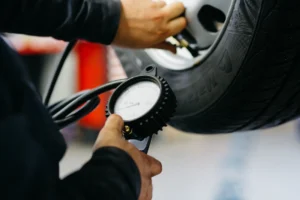
If you’re coming in for your April Inspection or just a routine check-up, ask us to “Pressure Test” your cap. It takes us two minutes with a special pump. If it fails, we swap it out for eighteen bucks, and you drive away knowing your engine isn’t going to turn into a pressure cooker on the way home.
Don’t let a $5,000 engine rebuild be the way you find out your $18 cap was worn out. Let’s keep that pressure where it belongs, inside the system, not on your wallet.
📞 Is your car running a little “warm” lately? Don’t risk a blowout. Call Boston Auto Group at 508-238-8162 or book your Cooling System Health Check online today!